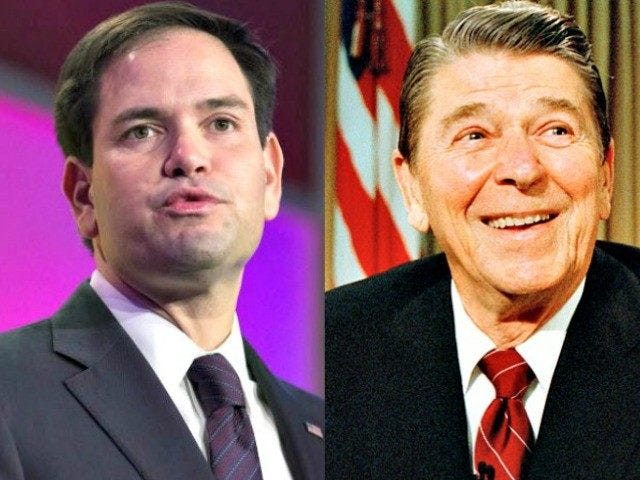
Ronald Reagan is often heralded by political supporters and opponents alike as the “Great Communicator”; as someone who could inspire the nation with simple prose that restored pride in our country and optimism about the future. The secret to this success was his ability to manipulate broadly shared symbols and beliefs about the nation’s identity, meaning, and purpose in the world (i.e. Civil Religion) to both cast doubt on the policies of the past and legitimize his ideological agenda. While every Republican this primary season has claimed to be the standard bearer for “The Gipper” none have more closely matched his rhetorical style as Marco Rubio; which leads me to ponder whether he will become this generation’s Great Communicator?
As a candidate for the Republican nomination in 1976, Governor Reagan argued that the Big Government philosophy of the status quo was not just bad for public policy; it violated the sacred principles upon which the nation was built and became exceptional. More importantly, he asserted that as president, he would restore those principles and our greatness. Consider the following excerpts from his speech, “To Restore America”:
I believe God had a divine purpose in placing this land between the two great oceans to be found by those who had a special love of freedom and the courage to leave the countries of their birth.
We’re Americans and we have a rendezvous with destiny. We spread across this land, building farms and towns and cities, and we did it without any federal land planning program or urban renewal.
If you want to restore government not only of and for but by the people; to see the American spirit unleashed once again; to make this land a shining, golden hope God intended it to be, I’d like to hear from you.
In these few lines, Reagan invokes civil religious themes that have a long history in American politics; that we are an exceptional nation, blessed by God, to lead the world as the “New Israel.” Taken in the context of public anxiety about the declining strength of our economy and influence over international affairs, it is not surprising that such exultations about the greatness of America found resonance among a large swath of the public. But more importantly, Reagan asserted that the glory days of our past were only possible because of our faithful adherence to the limited government philosophy of our founders; that our current decline was the result of big government run amok; and that we could once again become that “City on a Hill” by returning to those sacred principles. Although Reagan lost the 1976 primary to President Ford, he would win a decisive victory four years later with the same message.
Now consider Marco Rubio’s closing remarks at the most recent Republican debate and his “victory” speech after a third place finish in the Iowa Caucus(respectively):
The bible commands us to let our light shine on the world. For over 200 years, America’s light has been shining on the world and the world has never been the same again. But now, that light is dimming a little, after seven years of Barack Obama. And that’s why Monday night, what will happen here in Iowa is so important.
After seven years of Barack Obama, we are not waiting any longer to take our country back. This is not a time for waiting. For everything that makes this nation great now hangs in the balance. This is a time we need a president that will preserve, protect the constitution of the United States. Not one that undermines, attacks, and ignores the constitution of the United States. This is a time for a president who will defend our second amendment rights. Not a president who undermines them. This is a time for a president that will rebuild the U.S. Military, because the world is a safer and a better place, when the United States has the most powerful military in the world. This is no ordinary election. 2016 is not just a choice between two political parties. 2016 is a referendum. A referendum on our identity as a nation and as a people.
Although all Republicans criticize President Obama’s leadership and policies, few have done so in a manner that so closely resembles the civil religious rhetoric of Ronald Reagan. Rubio, like Reagan, has invoked the City on a Hill metaphor to remind the audience of American Exceptionalism. Rubio, like Reagan, has asserted that the perceived decline of our nation is attributable to a political opponent; one whom he not only disagrees with, but denigrates as an existential threat to the nation’s identity and survival in the years to come. But most importantly, Rubio, like Reagan, has also articulated a means of restoring the greatness of America; and coincidentally enough, the solution lies in a limited government philosophy and his own rise to power.
None of this is to suggest that I believe Marco Rubio would be a good president or that he will win the Republican primary. Nor do I believe that employing civil religious rhetoric is normatively good for our politics or democracy. In fact, my own research suggests that it is more likely to exacerbate ideological differences as policy debates evolve into existential battles for the nation’s soul. But, it is clear to me that of all the candidates, Rubio has most closely adopted the rhetoric of the most successful and beloved Republican President since Lincoln. While Donald Trump has similarly blamed Obama for all of our troubles and promised to “Make America Great Again”, Rubio has done so in a more palatable form by invoking these shared civil religious symbols and beliefs.

 Flavio Rogerio Hickel Jr.