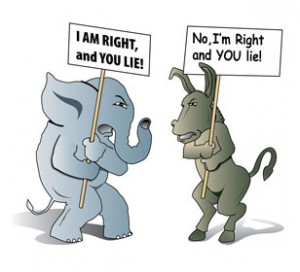
What does the victory of Bernie Sanders in the New Hampshire primary mean? In all likelihood, it means more than what most of us would think and less than what the candidates and pundits would have us believe. I’m humble enough to admit that I don’t have all the answers, but I do believe that this election, and the primary campaign thus far, says a great deal about what the Democratic electorate (and perhaps Republicans as well) has learned from the Obama Presidency.
Regardless of whether Sanders or Clinton successfully run the gamut of the primary season or win the general election, Democratic voters have signaled (through their rejection of O’Malley and the tight race between these two partisan warriors) that they don’t care what Republicans think about their nominee. The Obama presidency has taught the Democratic electorate that regardless of the policy positions adopted or the rhetoric employed by their candidates, Republicans in Congress aren’t going to play ball with a Democratic President.
The political fact that the last six years of a Republican controlled Congress were among the least productive in U.S. history is not debatable; however, reasonable people may disagree on why that is so. One could claim that Congressional gridlock was the inevitable result of Democratic policies and proposals that were simply too extreme for the Republican Party and its conservative constituency to stomach. While plausible arguments could be made to this effect, it’s hard to maintain that fiction when the lion’s share of Republican opposition to all things Obama was derived from their hatred of ObamaCare; which was essentially a rehashed version of RomneyCare; which itself was essentially a rehashed version of the Republican counter-proposal to the Clinton health care plan of the 1990s. More convincingly, the illusion of a principled opposition inundated by radical lefty politics is destroyed when we consider the well documented strategy adopted by the Republican Senate on the eve of Obama’s inauguration to make him a one-term president by opposing everything he proposed (regardless of how moderate those positions were or whether they incorporated or were modeled off positions advanced by Republicans in the past).
To be fair, it’s not clear that Democrats would behave any differently with a President Cruz, Kasich, or (God-Forbid) Trump. It’s hard to argue with the logic that the opposition party reaps more benefits from denying the president bragging rights for legislative victories than contributing to those accomplishments (where they often get little credit). Consequently, there seems little inherent reason to suspect that Democrats would be any less obstinate with a Republican president in this polarized political environment. Unfortunately, this suggests that we are no closer to finding a way out of the wilderness.
Obama’s hope and change sales pitch in 2008 was predicated on the argument that he could rise above the partisan fray to find common ground in a polarized polity. Although many books will likely be written about why that hasn’t happened (and yes, some of the blame will fall on Obama), Democratic voters don’t seem to be willing to play that game again. They have learned that extending the olive branch to Republicans in Congress is a waste of time. If the $300 Billion in tax breaks included in the 2009 Stimulus and abandonment of the single-payer option for ObamaCare couldn’t buy some good will, then what can? The Democratic electorate wants someone who can serve as an effective counter-weight against the Republican Congress (which, thanks to the Gerrymandering of 2010, isn’t going to lose its majority in the near future). Although there are significant differences between Clinton and Sanders, it is clear that both will serve as partisan warriors for the Liberal, Democratic cause.
But, it is also clear that neither candidate will inspire a spirit of compromise from the Republican opposition. Despite the latest talking points from the Clinton campaign that she is more “pragmatic” and “knows how to get things done”, does anyone really believe that a Republican Congress would be more prone to work with her (whom they despise — perhaps more than Obama — for the better part of three decades) than Comrade Sanders? Will the Sandernista political revolution bring the Republicans to heel?
No — clearly either candidate would enter the White House with a severe handicap and face a similarly uncooperative Congress as Obama has (perhaps more so). The difference in the Democratic electorate between now and eight years ago is that the wool has been pulled from their eyes. They have learned that a partisan peace is a pipe dream in the current political environment and that they can’t allow Republican obstructionism to influence their decision in the primaries.
In many ways, this analysis could also be applied to the Republican primary and the inexplicable longevity of Trump and Cruz. From a conservative perspective, their agenda has been stymied by an obstinate president that flaunts his power at every turn and disregards their majority status in Congress. It might be reasonable for them to believe (as Democrats do) that no matter who they choose or how moderate they may be, the opposition will never assent. Perhaps then, it makes sense to through your support behind an unapologetic advocate of the conservative cause.
Right or wrong, the Obama Presidency has led both parties to abandon the hope of a partisan peace for an ideological war. The primary elections are simply a means of deciding who their champions will be.

 Flavio Rogerio Hickel Jr.